
Most GEO and AEO work, meaning work to get a business named in ChatGPT and Google’s AI answers, is billed as a monthly retainer. In an October 2026 study of 214 agencies, 68% priced it that way, and the rest sold projects, audits, hourly help or performance fees (First Page Sage).
The model you buy sets what each report has to prove, so start with the model.
The Six Ways Agencies Bill for GEO, Plus the Tool Option
Only 23% of the 214 agencies in that study published any GEO or AEO price, so most quotes arrive as a custom proposal (First Page Sage). The table shows each model’s share and typical term from the study, plus what its report should show you.
| Pricing model | Share of agencies | Typical term | What each report should show |
|---|---|---|---|
| Custom retainer | 41% | 6 months | The work shipped that month, matched to the agreed scope, plus calls and booked jobs. |
| Tiered package retainer | 27% | 3 to 6 months | Each deliverable the tier promises, checked off by name. |
| Project or sprint | 13% | 30 to 90 days | The fixed deliverable list marked done or open, and a retest at the end. |
| One-time audit | 8% | 2 to 6 weeks | Findings tied to your site and profiles, ranked by what to fix first. |
| Hourly consulting | 6% | None | Hours by task, and what each task changed. |
| Performance-based | 5% | 6 to 12 months | The counted results, using the counting rule written into the contract. |
| Tracking tool subscription | Software, outside the agency study | Monthly or annual | The tool’s answer log. Your team still owes the fixes. |
Agency rows come from First Page Sage’s 2026 report: 1,146 quotes from 214 agencies, collected July 6 to October 2, 2026. First Page Sage sells GEO work, and its report lists dollar figures we left off this page. The tool row comes from HubSpot.
Tracking tools bill as a subscription, usually tiered by how many prompts they track and how many AI engines they cover. HubSpot notes that most of these tools track and report rather than create or publish content (HubSpot).
Performance fees are the rarest model. Agencies that offer them tie the fee to tracked AI mentions or recommendations. Buyers in the study reported trouble agreeing on how those results get counted (First Page Sage).
What Moves a GEO Quote Up or Down
Scope sets the price more than the label on the invoice does. HubSpot lists five cost drivers, and each one maps to something an owner can count before asking for a quote (HubSpot).
- Content scope. How many pages get written or reworked. For a plumber, that means service pages such as water heater replacement. For a firm, it means practice area pages.
- Schema and entity work. Keeping your business details consistent across your site, profiles and review sites.
- Off-site authority building. Earning mentions on review sites, industry press and forums. HubSpot calls it the widest swing between lean and high-investment programs.
- Monitoring coverage. Tools price by prompts tracked and engines covered, so more services, towns and assistants cost more.
- Reporting depth. A basic dashboard costs less than competitor benchmarking and citation analysis.
Trade and market move the price too. First Page Sage found home services had the lowest median price of the 11 industries it tracked, because most of those engagements cover one local market. Legal pricing rose fastest, up 42% from 2025, as firms competed on practice-area questions (First Page Sage).
| Business | Prompt math | Answers to read each month |
|---|---|---|
| Plumbing company | 4 services × 3 towns × 2 phrasings = 24 prompts | 24 prompts × 3 assistants = 72 answers |
| Law firm | 2 practice areas × 2 cities × 2 phrasings = 8 prompts | 8 prompts × 3 assistants = 24 answers |
Example only. The counts are picked to show how coverage multiplies. They are not a recommended panel size or Ostmen client data.
Ask any quote how many prompts it tracks, in which assistants, and how often it reruns them. Those answers explain most of the monitoring line.
Which Model Fits Your Business: A Four-Question Decision Tree
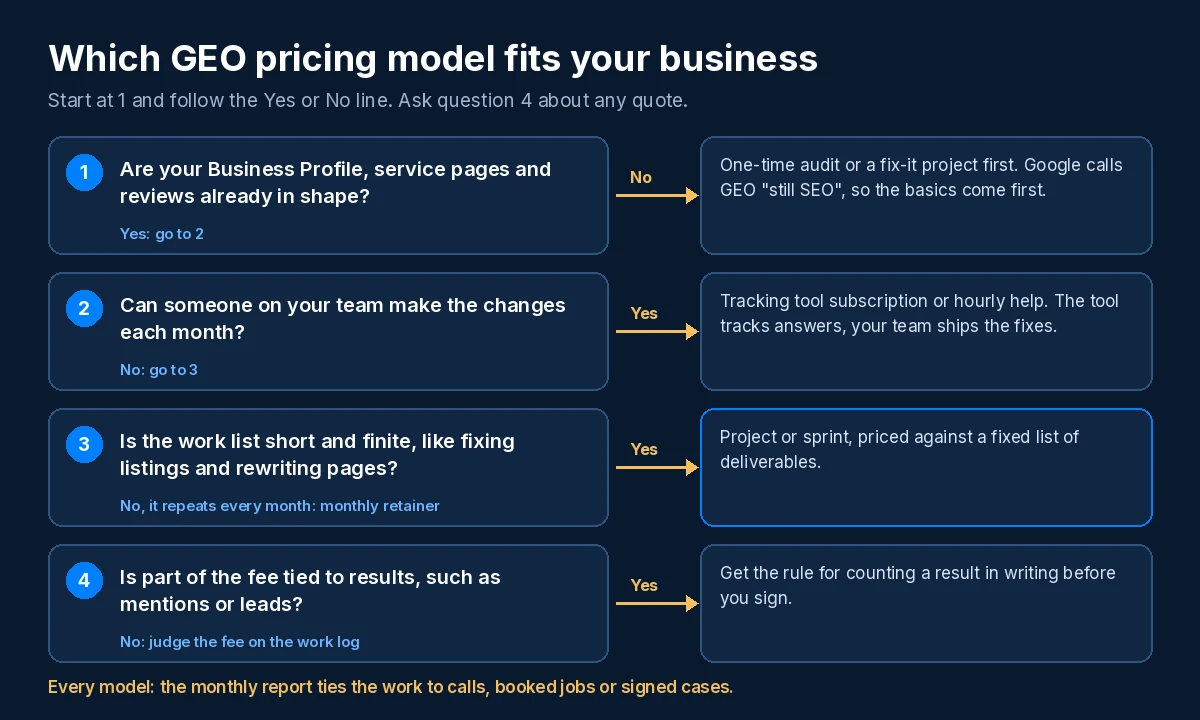
- Are your Business Profile, service pages and reviews already in shape? If not, start with a one-time audit or a fix-it project. Google says optimizing for its AI features is still SEO, and it points anyone weighing GEO services to its guidance on evaluating third-party SEO advice (Google Search Central).
- Can someone on your team make the changes each month? If yes, a tracking tool or hourly help can cover it. The tool shows where you get named, and your team ships the fixes.
- Is the work list short and finite? Fixing listings and rewriting a set of pages fits a project or sprint. New pages, review requests and off-site mentions every month fit a retainer.
- Is part of the fee tied to results? Get the counting rule in writing first. It should say what counts as a result, which assistants get checked, and how often.
If you are holding a quote right now, our AI search visibility service page shows how we scope this work for service businesses and law firms.
Teardown: A Sample Monthly GEO Report, Line by Line
Below is a made-up report for a plumbing company on a retainer. It holds no figures at all, so read the wording and the order of the lines. To read the prompt panel numbers themselves, use our guide to measuring AI search visibility.
Illustrative only. This is not a client report, and it contains no client data.
-
1Scope and Model
“Retainer. This month: rewrite the water heater replacement page and fix outdated hours on directory listings. Also add the service area towns to the Business Profile.”
Why it is there: it ties the invoice to the work. Under a retainer or tiered package, each promised deliverable shows up here by name.
Push back if you see: “Ongoing optimization.”
-
2Work Shipped, With Proof
“Water heater replacement page rewritten and live (link). Directory hours corrected (before and after screenshots). Service area towns added to the Business Profile.”
Why it is there: you can check each item yourself. On hourly billing, this line also lists the hours spent per task.
Push back if you see: a task list with no links, screenshots or dates.
-
3AI Answer Check
“Named in X of N answers, shown per assistant and per service, on the same prompts and settings as last month. Prompt changes this month: none.”
Why it is there: AI answers can differ for the same prompt (HubSpot), so a rate over many answers per assistant is the useful number. Any change to the prompt list has to be stated, or this month cannot be compared with the last.
Push back if you see: one blended “AI visibility score” with no prompts behind it.
-
4Google’s AI Numbers
“Impressions in AI Overviews and AI Mode by page, from Search Console’s Generative AI performance report, compared with last month.”
Why it is there: this is Google’s first-party count. The report shows impressions in AI Overviews and AI Mode, grouped by page, country, date or device (Search Console Help).
Push back if you see: “AI clicks from Google” with no named source.
-
5Visits From AI Assistants
“Visits in GA4’s AI Assistant channel, by landing page.”
Why it is there: GA4 puts visits from ChatGPT, Gemini, Copilot and similar sources in its AI Assistant channel. Clicks from AI Overviews and AI Mode land in Organic Search instead (Analytics Help).
Push back if you see: one “AI traffic” number that never says which channel it counts.
-
6Calls and Booked Jobs
“Calls and form leads from AI assistant visits, plus callers who said an AI app sent them. Booked jobs from each group.”
Why it is there: this is the line the fee gets judged on. For a law firm, this line counts signed cases, and our guide to tracing a signed case to its source shows how to trace each one.
Push back if you see: mentions and impressions with no calls line at all.
-
7Next Month and Out of Scope
“Next month: rewrite the drain cleaning page, ask recent customers for reviews that name their town. Out of scope: paid directory placements and ad spend.”
Why it is there: next month’s work should come from the gaps in lines 3 to 6. The out-of-scope list keeps surprise charges off the next invoice.
Push back if you see: last month’s plan, copied word for word.
Match the report to the model you bought. A tool subscription’s report is mostly line 3, the answer log, so lines 1, 2 and 7 come from your team. A project report should end with a retest against the check it started from.
Questions Owners Ask About GEO Pricing
Does GEO cost more than SEO?
In First Page Sage’s dataset, the median GEO and AEO retainer ran 45% above the median traditional SEO retainer (First Page Sage). Google calls this work still SEO (Google Search Central), so ask which line items are new and which are SEO you may already pay for. Our sales call script for choosing a GEO agency covers how to ask.
What should a GEO proposal list before I sign?
HubSpot’s list: how many prompts get tracked and in which engines, how many pages get produced or reworked, schema and entity work, any off-site scope, and the reporting cadence (HubSpot). Add one more line for a service business: how calls and booked jobs will be reported.
Bring a GEO Quote or Report to a Call
Send us the proposal or last month’s report before a strategy call. We will go through it with you line by line and show which pricing model it uses and what each section should prove.
Book a Strategy CallSources, read November 24, 2026. First Page Sage: GEO & AEO Pricing Statistics: 2026 Report (October 7, 2026). HubSpot: How much does AEO cost? (updated September 8, 2026). Google Search Central: Optimizing your website for generative AI features on Google Search (last updated 2026-07-10 UTC). Search Console Help: Generative AI performance report (Search). Analytics Help: Default channel group.

Brock Anderson is the founder of Ostmen Marketing. He runs Google Ads, Local Services Ads and AI search visibility work for law firms and service businesses, and judges every channel by cost per signed case or booked job.