
A potential client just got in a car accident, got arrested, or is staring down an immigration deadline. In that moment, they are not calling one law firm. They often call several, and they often hire whichever one calls them back first. Everything else, your reputation, your case results, your years of experience, only matters to the firm that actually gets them on the phone.
This is speed to lead, and in legal marketing it is one of the most controllable, most ignored factors in whether a case gets signed at all.
How fast is fast enough? Call every new inquiry back within five minutes during business hours, with a live person, and send an automatic text the moment it arrives. After hours, the text goes out instantly and a person calls first thing. Most firms are nowhere close, which is why answering fast is one of the cheapest ways to sign more of the cases your marketing already pays for.
The Numbers Should Worry You
The best numbers here come from law firms themselves. In 2024, Clio had a research firm secret-shop 500 U.S. law firms by phone and email. Only 40 percent answered the phone. Counting firms that called back, 52 percent were reachable, which means 48 percent of firms could not be reached by phone at all. Only 33 percent answered the email inquiry. Clio ran a similar study in 2019, when 56 percent of firms answered the phone, so this is getting worse, not better.
Outside legal, the pattern is old and consistent. A Harvard Business Review audit of 2,241 U.S. companies, published in 2011, found the average company that responded to a web lead took 42 hours, and 23 percent never responded.
If your intake process takes even an hour, you are not competing on the quality of your work. You have already lost the case to whichever firm picked up the phone first.
Why This Hits Legal Harder Than Almost Any Other Industry
Every industry loses some business to slow response. Legal loses more, for a specific reason: the emotional and financial stakes often push people to call several firms at once, not to research for weeks the way they might shop for a contractor. A DUI arrest, a workplace injury, an immigration filing deadline. These are urgent, often frightening situations, and the person calling wants to talk to someone right now, not tomorrow morning.
That urgency is why the five-minute window matters so much in legal. A firm with a brilliant practice and years of results loses the case to a mediocre firm that simply answered the phone. The marketing spend that got the phone to ring in the first place gets wasted the moment nobody picks it up in time.
What We Can Control, and What We Cannot
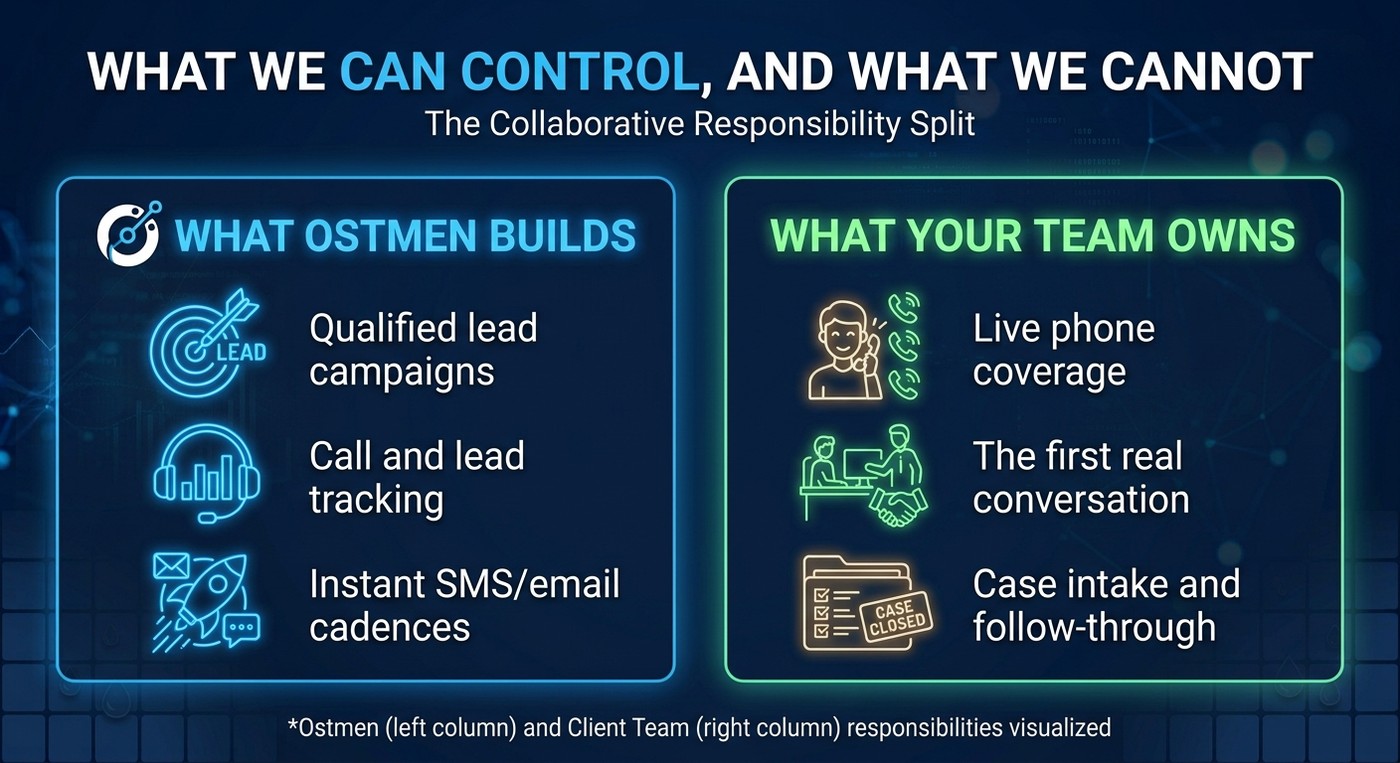
Here is the honest split, because pretending otherwise would not serve you. We build the campaigns that get qualified leads calling your firm. We build the tracking that tells you exactly where those leads come from. And we build the automated email and SMS cadences that follow up with every lead the instant they come in, so nobody falls through the cracks waiting for a human to notice.
What we cannot do is answer your phone for you. A law firm needs a live person, either in-house intake staff or an answering service built for legal intake, ready to have a real conversation almost instantly when a qualified lead calls. Automation can text back in seconds and keep a lead warm. It cannot replace the first live human conversation that actually signs a case. The firms that win combine both: instant automated engagement the moment a lead arrives, backed by a live team empowered and available to jump on the phone right behind it.
The First Five Minutes, Step by Step
The firms that answer fast are not the ones whose staff cares more. They are the ones where the next step happens automatically, and a person knows exactly what they owe the caller and by when. This is the sequence we set up for law firms, from the second a call or form comes in to the end of the day. Some steps belong to the system. The ones that sign cases belong to your intake team.
- Second 0The system
The call or form is tracked to its source and case type and routed the instant it arrives. Nobody has to check an inbox.
- Within secondsThe system
An automatic text and email confirm the inquiry came through and say a real person is calling shortly.
- Same momentThe system
Intake gets an alert with the caller's details and how they found you, so the call back is not a cold restart.
- By minute fiveYour intake team
A live person calls. This is the first real conversation, and it is the step that signs the case.
- If no answerYour intake team
Leave a voicemail and send a text, then make a second attempt on the schedule your firm sets.
- End of dayThe system
Every lead's status is tied back to its source and case type, so you can see where leads stall in intake, not just in marketing.
If you are weighing which channels should feed that sequence, our comparison of Google Ads and Local Services Ads for law firms covers how intake speed changes the answer.
Write the response standard down. A number on paper, like every new inquiry gets a live call attempt within five minutes during business hours, turns good intentions into something a manager can check. It comes down to whether there is a system forcing the behavior every single time, on the tenth call of the day and not just the first.
Questions Firms Ask About Speed to Lead
How quickly should a law firm respond to a new lead?
Within five minutes during business hours, with a live call, and with an automatic text right away. After hours, send the text instantly and call first thing the next morning.
What is speed to lead and why does it matter for law firms?
Speed to lead is how quickly your firm responds to a new inquiry. It matters more in legal because people with an urgent problem call several firms at once and often hire the first one that reaches them. In Clio’s 2024 secret-shopper study, 48 percent of law firms could not be reached by phone at all.
Can automation alone fix a law firm’s response time?
No. Automated SMS and email cadences can engage a lead instantly and keep it warm, but they cannot replace the first live conversation. Firms that win combine instant automated engagement with a live intake team ready to call back within minutes.
The Bottom Line
Speed to lead is one of the rare places in legal marketing where the fix is almost entirely in your control, and it is also one of the most commonly ignored. We can build the campaigns, the tracking, and the automated cadences that make sure no lead sits untouched. What closes the loop is a live team ready to pick up the phone in minutes, not hours.
At Ostmen Marketing, we build the tracking, the routing, and the follow-up cadences that give your firm the best possible shot at being first.
Want to Know Where Your Leads Are Sitting Too Long?
Book a strategy call and we will show you exactly where your current intake process is losing cases.
Book a Strategy CallSources: Clio, Are Law Firms Failing at Marketing and Client Engagement? (secret shop of 500 U.S. law firms, June 20 to July 5, 2024) and 2024 Legal Trends Report. Harvard Business Review, The Short Life of Online Sales Leads, March 2011.