Every pool company owner asks some version of this question eventually: should I run Google Ads, or should I invest in SEO? It usually comes from a good place, a limited budget and a desire to spend it on the thing that actually works. The honest answer is that PPC and SEO are not competitors. They solve two different problems on two completely different timelines, and the smartest pool companies use both, just not in equal measure at every stage.
Here is the real breakdown of each, and how to decide where your next dollar goes.
PPC: The Faucet You Can Turn On and Off
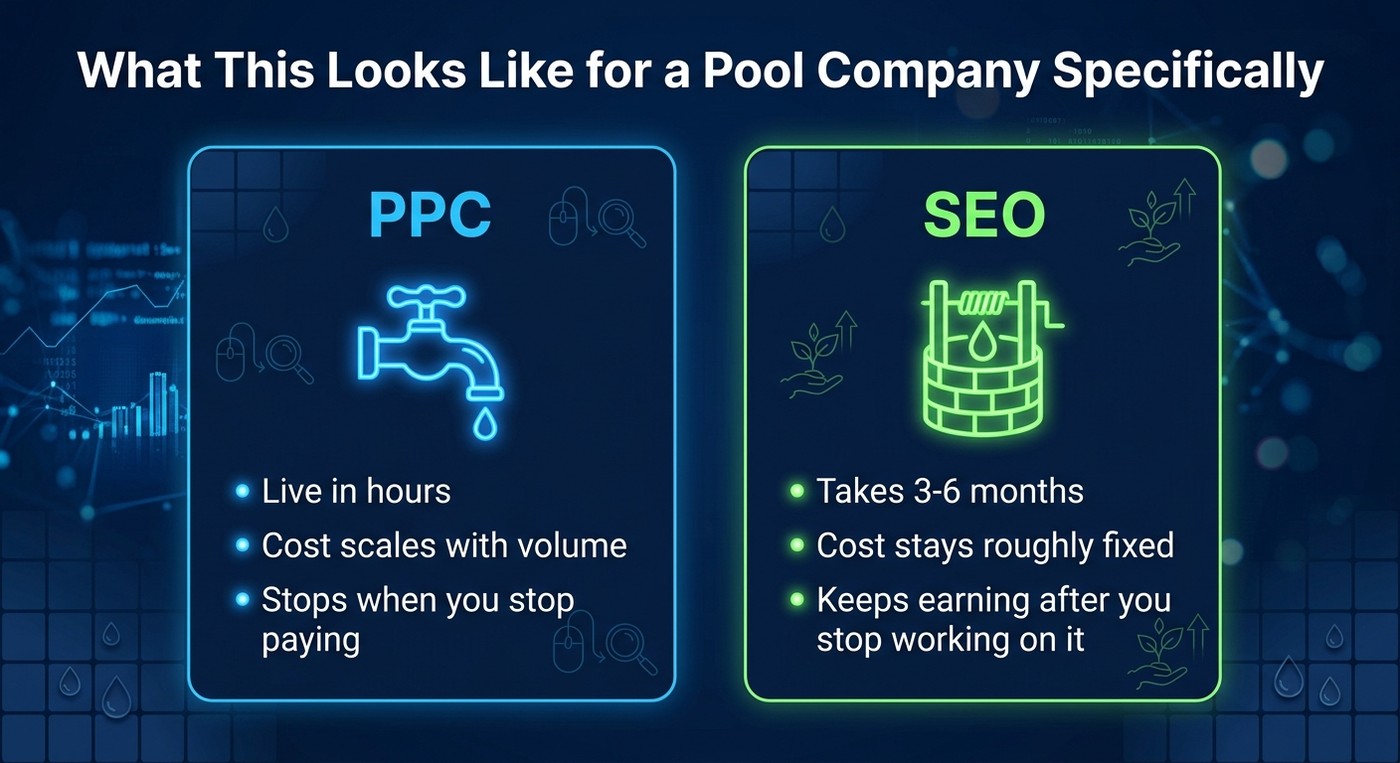
Pay-per-click advertising is immediate. Set up a campaign, and your ads can be live within hours, showing up for homeowners searching pool builders near me or pool remodel cost right now. You are buying visibility, not earning it, which means the moment you stop paying, the leads stop coming. Think of it as a faucet. Open it and water flows. Close it and it stops instantly. Nothing is stored up for later.
That immediacy is exactly what makes PPC valuable in specific situations. Launching a new service area, filling a slow month, testing a new offer, or needing leads in the next 30 days, PPC is the tool for all of it. In home services, cost per click typically runs $3 to $30 depending on market and competition, and results are measurable almost in real time. You know within days whether a campaign is working.
The tradeoff is that PPC costs are linear. Double your leads and you roughly double your spend. There is no compounding, no discount for loyalty, and clicks tend to get more expensive over time as competitors bid the same terms up.
SEO: The Well You Have to Dig
Search engine optimization works the opposite way. Nothing happens overnight. You are building rankings, content, and authority that Google has to trust before it rewards you with placement, and that trust is earned over months, not days. Most pool companies see meaningful movement in 3 to 6 months, with real compounding results in the 9 to 18 month range depending on how competitive the market is.
Think of SEO as digging a well. It takes real effort up front and nothing comes out for a while. But once you hit water, it keeps flowing without you paying for every gallon.
Once a page ranks, it keeps earning clicks without an additional dollar spent per visitor. That is the entire appeal. Where PPC cost scales with volume, SEO cost stays roughly fixed while the traffic it earns keeps growing. Businesses that stick with SEO for 12 to 18 months typically see their cost per lead drop well below what the same budget would produce in PPC over the same window, because organic traffic keeps compounding while paid traffic resets to zero the moment the campaign pauses.
The catch is patience. If you need leads in the next 30 days, SEO alone will not deliver them. It is not built for urgency. It is built for durability.
Why the Smart Move Is Both, Not Either
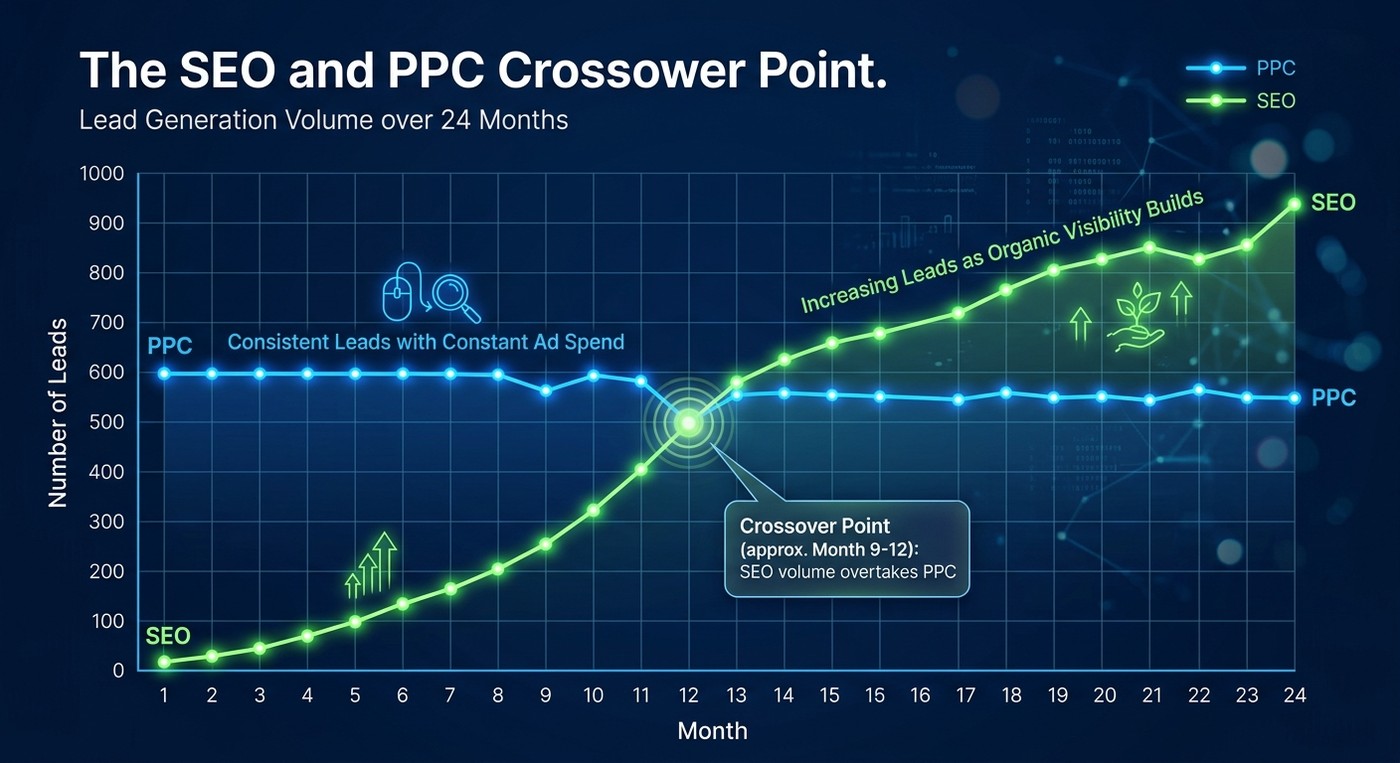
Pitting these two against each other misses the actual strategy. The businesses that win treat PPC and SEO as a relay, not a competition.
Here is how that looks in practice. Early on, or whenever a new season or service area needs immediate volume, PPC does the heavy lifting while SEO is still building in the background. As specific pages start ranking organically, usually starting with your easiest, least competitive terms first, you can start dialing back paid spend on those exact keywords, since you are now getting some of that traffic for free. The budget you free up gets reinvested, either into more competitive SEO terms or into PPC campaigns for the service lines that still need the immediate boost, like a build season surge or a new city you just expanded into.
This is not a one-time handoff. It is an ongoing adjustment. Review your rankings and your paid performance every quarter, and shift the mix based on where each channel is actually earning. A term that was purely PPC-driven last year might be ranking on page one organically now, which frees that budget for the next opportunity. Companies running combined PPC and SEO strategies see meaningfully higher overall ROI than those relying on just one channel, precisely because each covers the other's weakness. PPC covers SEO's slow start. SEO covers PPC's rising costs and total dependency on the ad budget.
What This Looks Like for a Pool Company Specifically
Apply this to the actual shape of a pool business. Build and remodel searches are high value and highly seasonal, which makes them a strong PPC target heading into spring, when you cannot afford to wait on organic rankings to catch the surge. Service and repair searches are steadier year-round and are excellent long-term SEO targets, since a homeowner searching pool pump repair near me in three years is just as valuable as one searching today, and by then that ranking should be costing you nothing per click.
A reasonable starting posture for most pool companies: run PPC aggressively on your highest-intent, most seasonal terms while SEO work goes on in the background for 6 to 12 months, then start shifting budget as rankings land. Revisit that mix every quarter.
The Bottom Line
There is no universal right answer to PPC versus SEO, only a right answer for your timeline and your budget. Need leads now, PPC is the faucet. Building for the next three years, SEO is the well. Most pool companies need both, sequenced and adjusted as the data comes in, not chosen once and never revisited.
At Ostmen Marketing, we build and manage both channels together for pool companies, and we treat the split between them as something to actively manage, not a decision you make once and forget.
Want the Right PPC and SEO Mix for Your Market?
Book a strategy call and we will map the split that fits your season, your budget, and your timeline.
Book a Strategy Call