Most pool companies can tell you how many leads they got last month. Very few can tell you which specific ad, keyword, or campaign actually produced the customer who signed a $60,000 build contract. That gap is not a small technical detail. It is the difference between a marketing budget that gets smarter every month and one that just keeps spending on faith.
Here is what real tracking looks like, the tools that make it possible, and how we build the whole system so nothing falls through the cracks between the click and the signed contract.
Why Lead Count Alone Tells You Almost Nothing
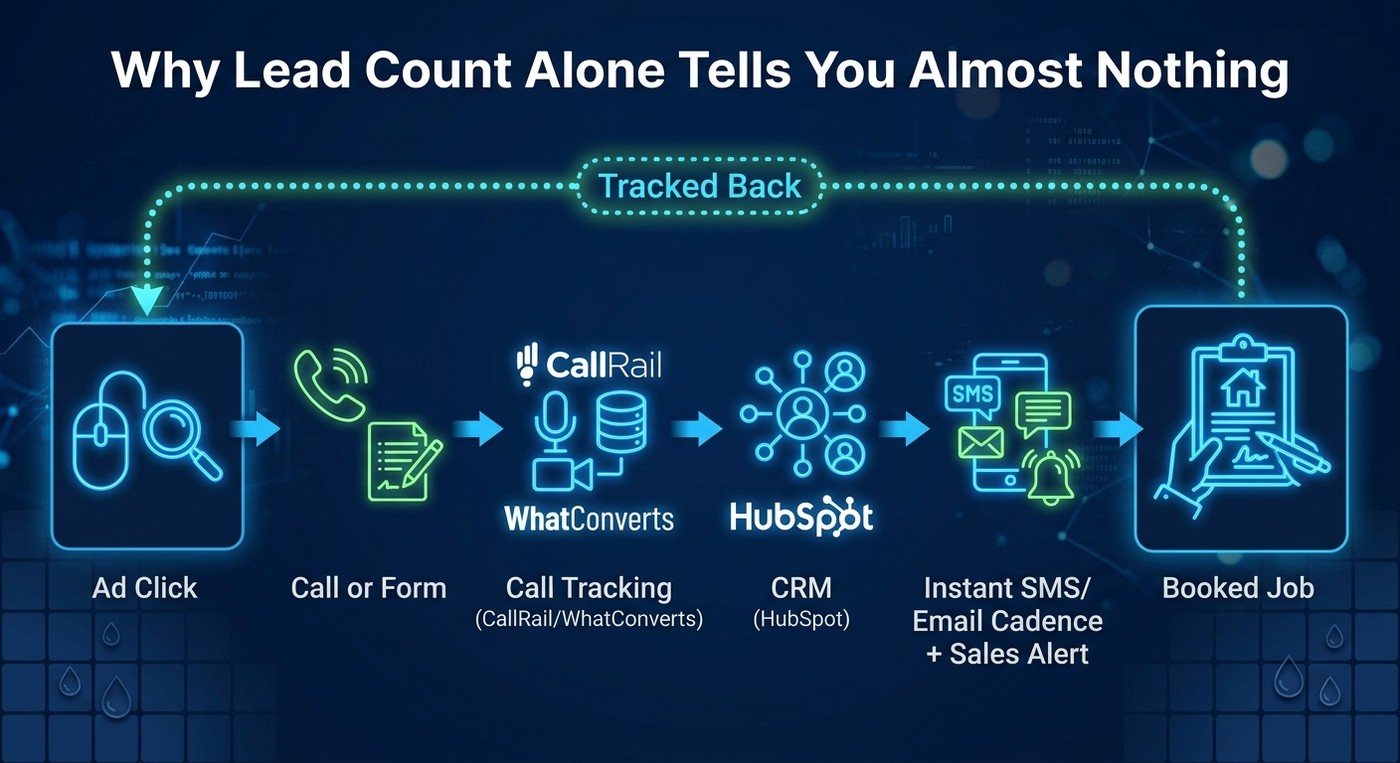
If all you measure is total leads, you cannot tell a $15,000 remodel inquiry from a wrong number, and you cannot tell which campaign produced which. That means you cannot make good decisions about where to spend next month's budget. You are optimizing in the dark.
Real tracking connects four things that most pool companies never actually link together: the specific ad or keyword someone clicked, the call or form they submitted, what happened to that lead in your sales process, and whether it closed. Once those four are connected, your marketing budget starts making itself smarter every month instead of staying static.
The Tools That Make This Possible
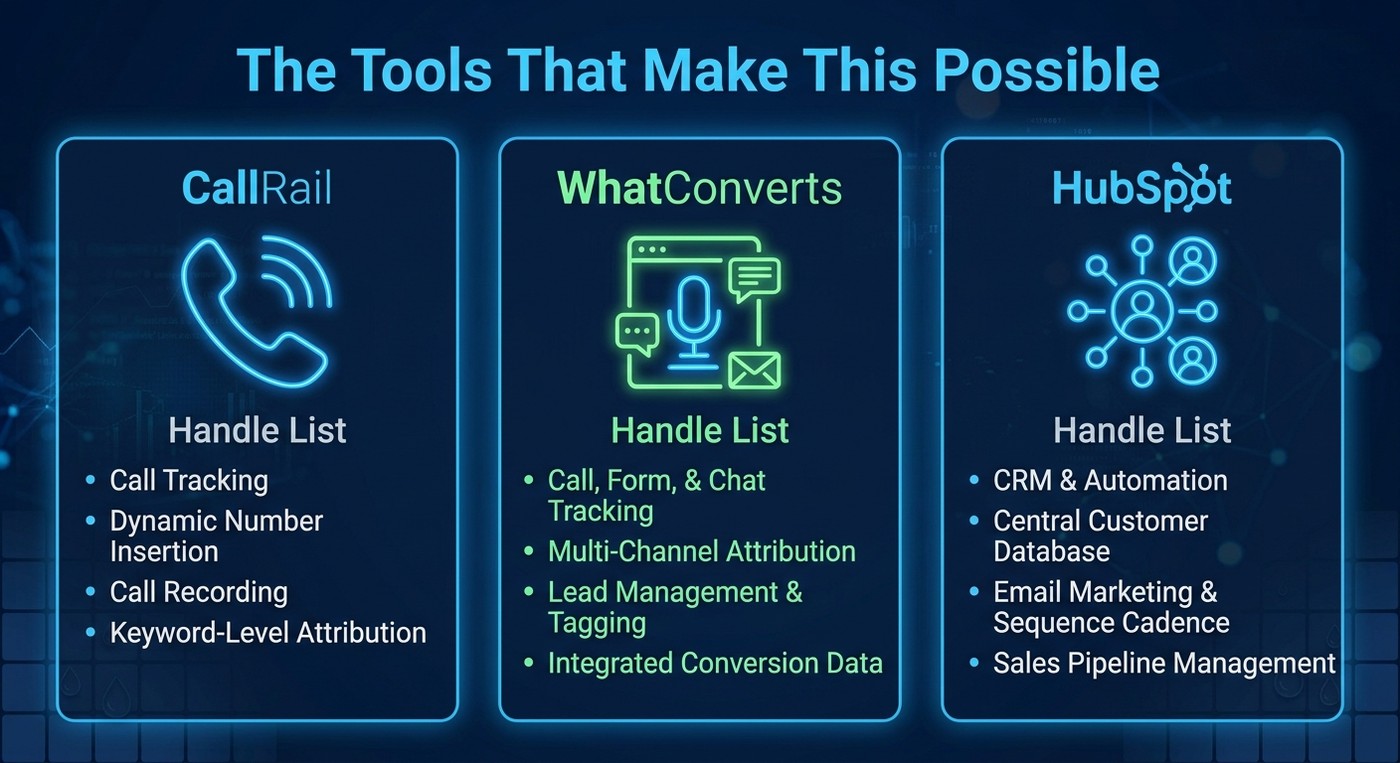
Call tracking is the foundation, since most high-value pool inquiries still come in by phone. Platforms like CallRail and WhatConverts assign unique tracking numbers to your campaigns, so every call gets tied back to the exact ad, keyword, or even the specific webpage that generated it. Both platforms record calls, transcribe them, and can even score caller sentiment, which starts to answer not just did the phone ring but was this a real prospect.
The two tools differ in a way worth knowing. CallRail is built primarily around call and text tracking with a broad integration ecosystem, while WhatConverts tracks calls, form fills, chats, and even ecommerce transactions in a single unified lead record, which matters if a prospect fills out a form on Monday and calls to follow up on Friday. WhatConverts treats that as one lead. Some other platforms count it as two, and then you are stuck reconciling the difference by hand.
A CRM is where the lead lives once it exists. HubSpot is the one we see most often and the one we integrate with constantly, since it can pull in call data, form data, and campaign attribution into a single contact record, then trigger automated workflows based on what happens on that call. If you are already running CallRail or WhatConverts, we connect it directly into HubSpot, or whatever CRM you already have, so nothing lives in a silo.
The point is not to collect data for a dashboard nobody opens. The point is to build a system where every lead automatically gets treated the way your best salesperson would treat it, every single time.
What Happens After the Lead Comes In
This is the part that actually moves revenue, and it is where most pool companies stop short. Capturing the lead is only half the system. What happens in the next five minutes decides whether it turns into a signed contract.
Here is how we build it. The moment a call or form comes in, it is scored and routed instantly, no manual step, no waiting for someone to check an inbox. From there it drops into an automated follow-up cadence, email and SMS, built specifically around your service mix, so a build inquiry gets a different sequence than a service call. At the same time, your sales team gets an instant alert so a real person can follow up while the lead is still warm, because automation supports the human step, it does not replace it.
Every stage of that sequence is tracked back to the original ad or keyword that started it, so months later you can look at a signed $60,000 build contract and trace it all the way back to the exact campaign that produced it. That is the full click-to-close loop, and it is what turns a marketing report from a guess into an actual answer.
If You Do Not Have This Set Up Yet
Most pool companies we start working with have some version of this, usually incomplete. Maybe there is a CRM but no call tracking feeding into it. Maybe there is call tracking but leads still get followed up whenever someone gets around to it. Either way, we build out whatever piece is missing.
If you already run CallRail, WhatConverts, HubSpot, or something else entirely, we integrate directly into it rather than asking you to switch tools you already know. If you have nothing in place, we will get you set up on the stack that fits your business, build the automated cadences, and configure the instant lead alerts so your team is never the bottleneck.
The Bottom Line
A pool company that tracks every lead from the first click to the signed contract has an unfair advantage over one that is just watching a lead count go up and down. It is the difference between spending your budget and investing it. The tools to do this well already exist and are not expensive relative to what they protect. The system just has to actually get built, connected, and maintained, which is exactly what we do for every client running paid campaigns with us.
At Ostmen Marketing, building this tracking system is part of how we run every pool company account, not an upsell.
Want to See What Your Tracking Setup Is Missing?
Book a strategy call and we will show you exactly where leads are slipping through the cracks today.
Book a Strategy Call